
Select macro-economic and demographic data for the country and the Bay Area
The Bay Area housing market hit a lot of national headlines in May. In San Francisco, Al and tech-driven demand has created aggressive bidding wars on the scarce inventory. Skyrocketing rents are back in the norm. Even the city’s condo market, which has been under pressure for six years, is showing signs of demand recovery.
For the first time in many years job creation in the Bay Area is positive and economic opportunity is attracting net inbound migration, despite the region’s chronic shortage of homes and affordability issues. It’s notable that other tech cities like Seattle and Austin are not seeing the boom in the real estate market related to Al. In fact, those cities are now sending more people to San Francisco than the reverse.
While the city dominates the headlines, many areas have not seen the massive wealth effect driving home buying demand like the city has. In this cycle, this resurgent demand is so far concentrated to a very small section in the city, and luxury markets in Peninsula and Marin.
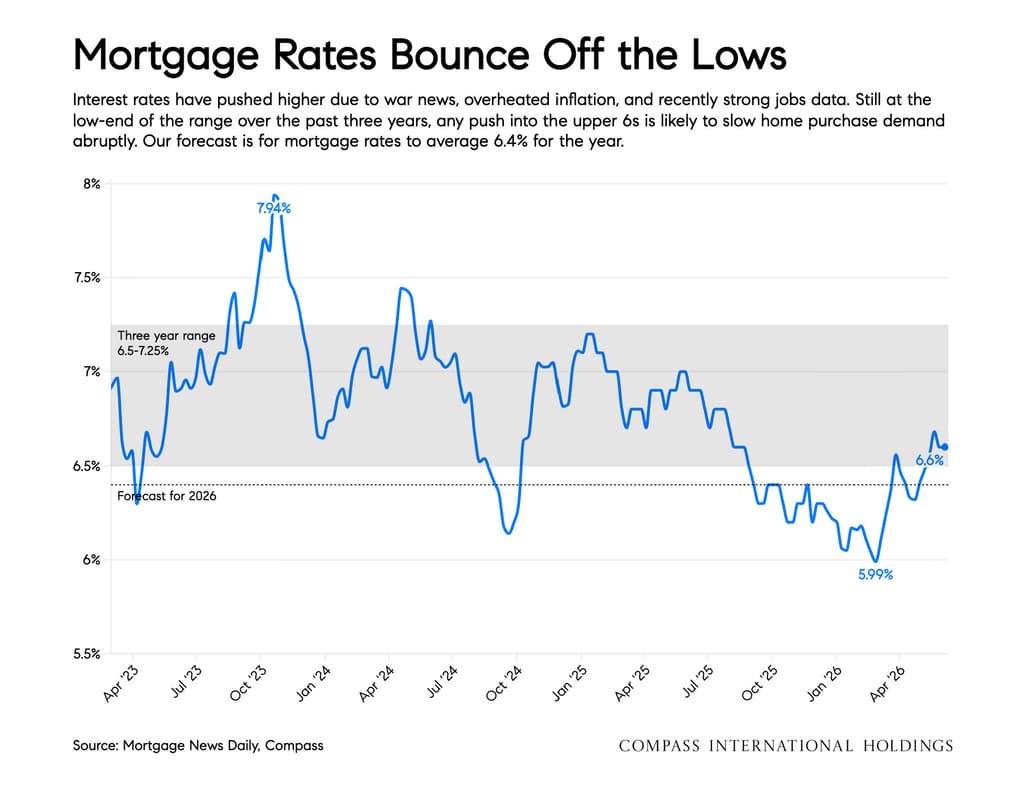
For much of the region, interest rates matter more than stock market performance. In May, mortgage rates jumped higher with sharply higher inflation data. That tension between higher interest rates and the wealth effect is likely to continue for the rest of 2026. Inflation pressures have been pushing higher, and it seems unlikely that interest rates will dip again very soon.

DISCLAIMER: Statistics are generalities, essentially summaries of widely disparate data generated by dozens, hundreds or thousands of unique, individual sales occurring within different time periods. They are best seen not as precise measurements, but as broad, comparative indicators, with reasonable margins of error. Anomalous fluctuations in statistics are not uncommon, especially in smaller, expensive market segments. Last period data should be considered estimates that may change with late-reported data. Different analytics programs sometimes define statistics – such as “active listings,” “days on market,” and “months supply of inventory” – differently: what is most meaningful are not specific calculations but the trends they illustrate. Most listing and sales data derives from the local or regional multi-listing service (MLS) of the area specified in the analysis, but not all listings or sales are reported to MLS and these won’t be reflected in the data. “Homes” signifies real-property, single-household housing units: houses, condos, co-ops, townhouses, duets and TICs (but not mobile homes), as applicable to each market.
City/town names refer specifically to the named cities and towns, unless otherwise delineated. Multi-county metro areas will be specified as such. Data from sources deemed reliable, but may contain errors and subject to revision. All numbers to be considered approximate. Many aspects of value cannot be adequately reflected in median and average statistics: curb appeal, age, condition, amenities, views, lot size, quality of outdoor space, “bonus” rooms, additional parking, quality of location within the neighborhood, and so on. How any of these statistics apply to any particular home is unknown without a specific comparative market analysis.
Median Sales Price is that price at which half the properties sold for more and half for less. It may be affected by seasonality, “unusual” events, or changes in inventory and buying trends, as well as by changes in fair market value. The median sales price for an area will often conceal an enormous variety of sales prices in the underlying individual sales.
Dollar per Square Foot is based upon the home’s interior living space and does not include garages, unfinished attics and basements, rooms built without permit, patios, decks or yards (though all those can add value to a home). These figures are usually derived from appraisals or tax records, but are sometimes unreliable (especially for older homes) or unreported altogether. The calculation can only be made on those home sales that reported square footage.
Photo use under the Creative Commons License: https://creativecommons.org/licenses/by-sa/2.0/
Compass is a real estate broker licensed by the State of California, DRE 01527235. Equal Housing Opportunity. This report has been prepared solely for information purposes. The information herein is based on or derived from information generally available to the public and/or from sources believed to be reliable. No representation or warranty can be given with respect to the accuracy or completeness of the information. Compass disclaims any and all liability relating to this report, including without limitation any express or implied representations or warranties for statements contained in, and omissions from, the report. Nothing contained herein is intended to be or should be read as any regulatory, legal, tax, accounting or other advice and Compass does not provide such advice. All opinions are subject to change without notice. Compass makes no representation regarding the accuracy of any statements regarding any references to the laws, statutes or regulations of any state are those of the author(s). Past performance is no guarantee of future results.