
A plain look at where the city’s fall market is slowing, where it isn’t, and why a home like our new Central Richmond listing still stands out.
If you’ve been to a few open houses this fall, you’ve probably felt it: fewer people in the room, fewer offers on the table, and more listings sitting past the two-week mark. The market is cooling. But at the very top of the market, homes are still trading at a healthy clip, and well-priced homes in good locations are still selling fast, often well over asking. What’s changed is how little room there is now for a listing that gets the price, the location, or the condition wrong.
We’re seeing this play out as we bring our newest listing to market: 647 24th Avenue, a rare opportunity to own a fully renovated single-family home in Central Richmond. More on that below. First, what’s driving the shift.
Why The Market is Cooling
After a rapid run-up in prices on limited inventory, higher interest rates have split the buyer pool. Some buyers have been priced out. Others are waiting on the sidelines until rates come down. That leaves a smaller group of buyers working through the fall inventory. A home that would have sold in a week this spring may now take longer to find its buyer.
The math behind that hesitation is real. We ran the numbers on a $2.5 million purchase with 20% down: a 100-basis-point rise in rates cost that buyer roughly $200,000 in buying power. Even if a seller drops the price by $100,000, the buyer’s monthly payment can still come out higher. So buyers wait for prices to adjust, and sellers, anchored to what the house next door got in the spring, wait for buyers to come back.
One of our clients sent us an old line that sums it up: every farmer’s wife told every farmer, “The weather looks bad, so don’t buy as much at the market this week, but don’t sell our crops for less than the usual price.” That’s where a lot of sellers are right now. Demand is down, but the price expectation hasn’t moved.
Timing plays a part too. October tends to bring some compression in the markets, and in a midterm election year, people move their money around and pay a little less attention to real estate.
Where The Run-up When, District by District
The run-up didn’t hit the whole city at once. It started in the central neighborhoods, Noe Valley and Cole Valley, then NOPA and Hayes Valley. From there it moved to Pacific Heights, Presidio Heights, and Cow Hollow, then out to Russian Hill, Nob Hill, and the Marina.
As buyers went looking for value, demand pushed south and west:
- District 9 condos. This is where the value still is. The large condo buildings have seen an uptick, but they haven’t appreciated nearly as much as two- to three-unit buildings or single-family homes.
- The Sunset and the Richmond. Both saw a strong run-up as buyers looked west for single-family homes.
- District 4. One of the biggest increases in the city, centered on Mount Davidson Manor, Balboa Terrace, St. Francis Wood, and Miraloma Park. We saw it firsthand: our Balboa Terrace listing sold for $1 million over list price this spring, and our Mount Davidson Manor listing closed $800,000 over list a couple of months ago.
A Tale of Two Price Points
The clearest split in the market right now is by price.
$10 million to $25 million: still moving. Homes listed in this range, particularly in Pacific Heights and Presidio Heights, are still selling quickly. Much of that is concentrated wealth, a lot of it from AI, with buyers arriving with $10, $20, or $30 million to deploy. Rates matter far less to this buyer. They have the liquidity, they’re still competing, and many feel good because they’re getting a better deal than they would have a year ago.
$2 million to $5 million: pulling back. This is where rates bite hardest and where we’re seeing the most hesitation. There are fewer “unicorn” buyers willing to stretch, and sellers are feeling it. A typical story this fall: a home goes on at $1.995 million with the seller expecting $3 million or more. Instead of ten offers, it gets three, coming in around $2.6 to $2.7 million. The seller hesitates, the open house energy isn’t what it was in the spring, and the listing gets repriced.
The $1 Million Over-Asking Club
Here’s a number that shows how unusual this year has been. So far in 2026, more than 250 San Francisco homes have sold for $1 million or more over asking. The previous record was in 2021, at roughly 50, and the next-highest year was around 42. Whatever happens in the last two months, this year is already about five times the old peak.
Part of that is money. Part of it is psychology. For a while, paying a million over asking was a kind of quiet status symbol: not a Ferrari in the driveway, but a modest-looking house you won the hard way. For many of these buyers, it wasn’t about the price. It was the hunt, and the feeling of winning against a crowd.
That momentum works in both directions. When buyers don’t see other people hunting, they don’t feel the need to either. The monthly count of $1 million-over sales ran around 15 to 18 early in the year, peaked in July and August, and slid back to about 15 in September. We expect October to come in near 10, which could make it the slowest month of the year for these sales.
What Sells in Two Weeks, and What Sits
A cooling market still has homes selling fast. When we pulled six months of comparable sales for 647 24th Avenue, the pattern was striking:
- Sold: Apart from one outlier, every home sold within about two weeks, typically 30% to 40% over asking.
- Pending: The same pattern. These are on track to close 30% to 40% over asking, after about 16 days on market on average.
- Still active: These have been on the market 30 to 40 days. When everything around you sells in two weeks, a month on the market means something is wrong.
What’s wrong is usually location, price, or both. A lot of the stale inventory is flips, bought when everyone assumed prices would keep climbing. One sits at a busy intersection with an electric bus stop out front, so there’s no parking and a steady stream of riders getting on and off. Another faces a car dealership’s lot just off the freeway. No buyer is going to pay a million over asking to look at a bus stop or a showroom.
One of those sellers listed at $2,495,000 hoping for $3.5 million and a “million over” headline. When that didn’t happen, they raised the price to $3,100,000, a $600,000 jump, and are still holding out for more. It’s an extreme case, but it shows the shift: pricing for a unicorn bid that isn’t coming only adds days on market.
Case in Point: 647 24th Avenue
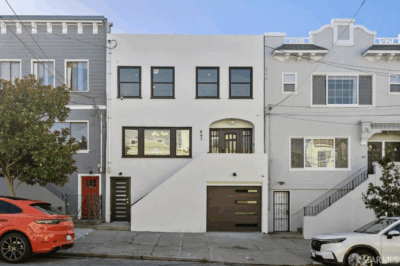
The homes still selling well aren’t always in the most famous locations. They’re homes without a deal-breaker, finished well, and priced to what the block supports. That’s the thinking behind our new listing at 647 24th Avenue: a rare opportunity to own a fully renovated single-family home in Central Richmond.
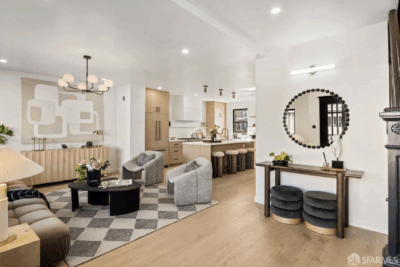
- Fully renovated and expanded. A 1916 home with 5 bedrooms, 4 bathrooms, and about 2,535 square feet, keeping its hardwood floors and classic details.
- Built for how people live now. An open chef’s kitchen with a stone island and a Wolf range, a great room that opens to the backyard, and a flex room that works as a fifth bedroom, guest suite, or office.
- A full-size lot with a flat backyard. The kind of outdoor space buyers leaving condos are holding out for.
- A normal, residential street. No bus stop at the front door and no dealership across the street. Geary Boulevard’s shops and transit are close by, with Golden Gate Park and Ocean Beach a short trip away.
In a market where buyers are looking harder at every detail, a renovated house on a good block with room to spread out is what still draws them in. We waited for final sign-off on the renovation before taking offers, so buyers know exactly what they’re getting. Reach out to us for open house times and the offer date.
The Montgomery Lee Take
This fall’s market rewards accuracy. Sellers who price to what their block has supported recently, fix the obvious issues, and are honest about their home’s location are still getting strong results. Sellers chasing last spring’s headlines are sitting.
For buyers, this fall may be the best window in a while. There’s less competition at open houses, more room to negotiate on homes that have lingered, and sellers who are more willing to listen. The key is knowing which homes are sitting because of price, which you can negotiate, and which are sitting because of location, which you can’t fix.
If you’re thinking about buying or selling in San Francisco this fall or next spring, let’s talk about what your neighborhood, and your specific block, is doing right now.
Frequently Asked Questions
Q: Is the San Francisco housing market crashing?
No. It’s cooling, and unevenly. Well-priced homes in good condition are still selling in about two weeks, often 30% to 40% over asking. What’s changed is that overpriced listings, or homes with a location problem, are now sitting for a month or more.
Q: Which price range is slowing down the most?
The $2 million to $5 million range. These buyers are the most sensitive to interest rates, and fewer of them are willing to stretch. Above $10 million, especially in Pacific Heights and Presidio Heights, homes are still trading at a healthy pace.
Q: How much do higher rates affect what I can afford?
More than most people expect. On a $2.5 million purchase with 20% down, a one-point rise in rates costs roughly $200,000 in buying power. A small price cut often doesn’t offset a higher monthly payment.
Q: Are homes still selling for $1 million over asking?
Yes, but less often. More than 250 homes have sold $1 million or more over asking this year, about five times the 2021 record. The monthly pace is slowing, though, and we expect October to be the slowest month of the year for these sales.
Q: Why are renovated single-family homes in the Richmond still selling well?
Because they give buyers what they’re holding out for: a house with a yard, no shared walls, and no HOA, while staying in the city. When the home is move-in ready and on a quiet residential block, buyers don’t have to discount it for work or for location, and that keeps the competition strong.
Q: My home has been on the market for 30 days. What should I do?
Look hard at price and positioning before anything else. When comparable homes are selling in two weeks, a month on market usually means buyers see a gap between the price and the property. Raising the price to chase a bigger number rarely helps.
Q: Is now a good time to buy?
For many buyers, yes. There’s less competition and more room to negotiate, especially on homes that have been sitting. Just make sure you understand why a home is sitting before you write an offer.